
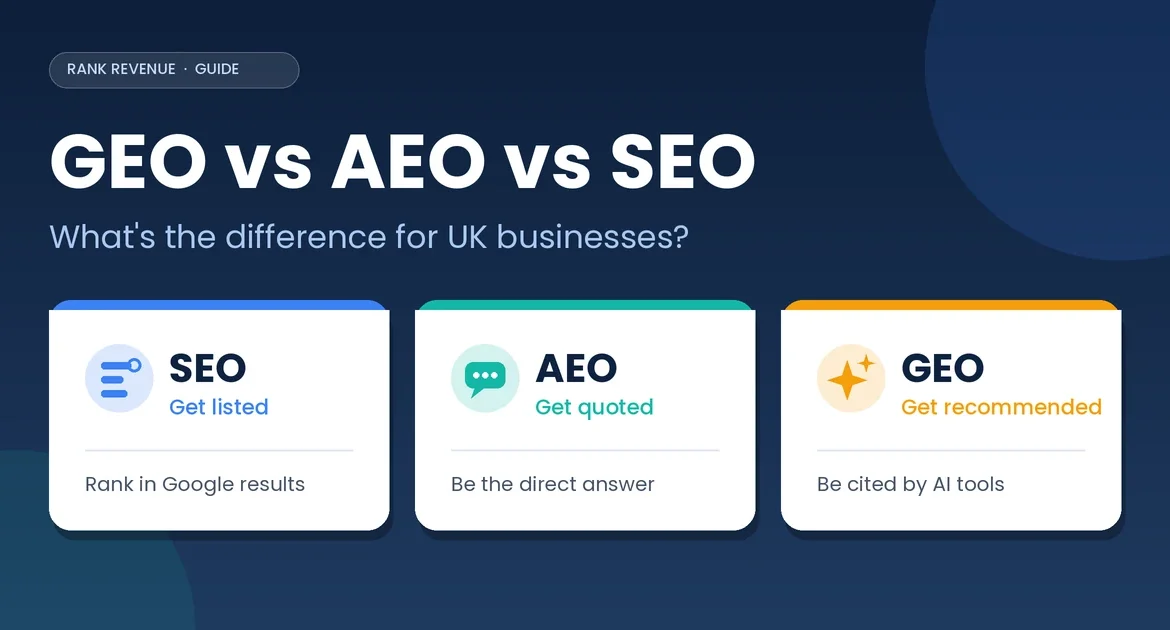
SEO helps your website rank in Google’s normal search results. AEO (Answer Engine Optimisation) helps your content get chosen as the direct answer to a question. GEO (Generative Engine Optimisation) helps your business get mentioned or cited when AI tools such as ChatGPT, Gemini and Google’s AI Overviews write an answer. All three depend on the same foundations.
If you run a business in the UK, you have probably heard all three terms in the past year, often from someone trying to sell you something. The GEO vs AEO vs SEO question gets confusing because the terms overlap, and some providers present them as three separate products. They are not three separate jobs. This guide explains what each one means, where they differ, where they overlap, and what is worth your time first.
What is SEO?
SEO (Search Engine Optimisation) is the work of making your website easier for search engines to find, understand and trust, so your pages show up higher in the normal list of results on Google and Bing.
It usually covers five areas:
- Technical health: your pages load quickly, work on mobile, and can be crawled and indexed without errors.
- On-page relevance: each page targets a clear topic, with titles, headings and copy that match what people search for.
- Content: useful pages and articles that answer real questions in more depth than competing sites.
- Authority: links and mentions from other trusted websites, plus reviews that show real customers use you.
- Local signals: a complete Google Business Profile and consistent business details if you serve a specific area.
Take a plumber in Dudley. When someone searches “emergency plumber Dudley”, SEO decides whether that plumber appears on page one or page four. A fast site, a dedicated Dudley page, strong reviews and a few local links all push in the right direction.
SEO is still the starting point for everything else. Google’s AI features draw on pages that Google can already crawl, index and trust, so a site with poor technical SEO health rarely shows up in AI answers either.
What is AEO (Answer Engine Optimisation)?
AEO is the practice of structuring content so a search engine or assistant can lift it and show it as the answer to a specific question. The aim is for your words to become the answer, not just a link near it.
You see AEO at work in:
- Featured snippets at the top of Google
- “People also ask” boxes
- Voice answers from Siri, Alexa and Google Assistant
- The opening lines of Google’s AI Overviews
Content that does well for AEO tends to follow a few simple habits. Headings are written as the questions people actually ask. The first one or two sentences under each heading give a complete answer, usually in 40 to 60 words. Lists, steps and tables are used where they genuinely help, and any structured data on the page matches what visitors can see.
Say a customer types “how much does a boiler service cost in Birmingham?” A page that opens that section with a clear price range and what affects it has a far better chance of being quoted than a page that buries the figure in paragraph six. Our own guide to what SEO costs in the UK opens with a two-sentence answer for exactly this reason.
One honest caveat: AEO wins visibility, not always visits. If the answer is complete on the results page, some people will never click. That still has value, because your brand is the one they read, but it works best on questions where people usually want to know more before they buy.
What is GEO (Generative Engine Optimisation)?
GEO is the work of making your business easy for AI tools to understand, trust and recommend, so you are named or cited when they write an answer. It covers ChatGPT, Perplexity, Gemini, Microsoft Copilot, Claude, and Google’s AI Overviews and AI Mode.
The big difference from AEO is scale. An answer engine only has to trust one passage on one page. A generative tool that recommends a business is weighing everything it can find about you, including your own site, your reviews, directory listings and what other websites say.
That is why GEO goes beyond formatting:
- Consistent business details: your name, address, phone number, services and description match on your website, Google Business Profile, Bing Places, social profiles and review sites.
- Third-party evidence: genuine reviews, press coverage, client mentions, and answers on forums and industry sites that AI tools draw on.
- Depth and originality: pages that cover a topic properly and include something worth citing, such as your own prices, timelines, results or local knowledge.
- Crawler access: AI crawlers are allowed to read your site, and your key facts sit in the page text rather than hidden in images or scripts.
- Monitoring: AI answers change between sessions and over time, so GEO includes checking regularly what these tools say about you.
Picture someone asking ChatGPT, “Who is a good dentist for nervous patients in Solihull?” The practices most likely to be named are the ones with clear service pages, consistent details across the web, and plenty of reviews that actually mention nervous patients.
GEO is not the same as local or geographic SEO
This trips up a lot of UK business owners. In this context, GEO stands for Generative Engine Optimisation, not geography. Ranking in your town, appearing in the Google Map Pack and building location pages all fall under local SEO campaigns. The two do help each other, because accurate local details and reviews feed straight into what AI tools say about you, but they are different disciplines.
GEO vs AEO vs SEO: the key differences
Swipe the table sideways to see all columns →
| SEO | AEO | GEO | |
|---|---|---|---|
| Main goal | Rank your pages in search results | Have your content chosen as the direct answer | Have your business cited or recommended in AI answers |
| Where you appear | Google and Bing results pages | Featured snippets, People also ask, voice answers, top of AI Overviews | ChatGPT, Perplexity, Gemini, Copilot, AI Overviews and AI Mode |
| What it rewards | Technical health, relevant content, links, reviews | Question-led headings, short direct answers, clean structure | Consistent brand details, reviews, mentions, depth, original information |
| How you measure it | Rankings, clicks and organic enquiries in Search Console and GA4 | Snippet and People also ask ownership | How often AI tools mention you, and whether they describe you correctly |
| What the user does next | Clicks through to your site | Often reads the answer without clicking | Shortlists the businesses the AI names |
A simple way to remember it: SEO gets you listed, AEO gets you quoted, and GEO gets you recommended.
Where SEO, AEO and GEO overlap
In practice, most of the work serves all three at once. Generative tools still retrieve passages from web pages before they write, so a page that ranks well and answers clearly is the same page they are most likely to cite. AEO is best thought of as one part of GEO rather than a separate strategy.
The shared work looks like this:
- Pages built around the questions customers really ask
- A direct answer near the top of each section, then the detail
- Facts that are specific, current and easy to check
- Named authors with real experience, and visible “last updated” dates
- Structured data that matches what is on the page
- Internal links that connect related pages clearly
- Reviews and mentions that confirm you are who you say you are
Good on-page SEO, such as matching headings to real questions and putting the answer first, now pays off in normal results, answer boxes and AI tools at the same time.
Does AEO or GEO replace SEO?
No. AEO and GEO are extensions of SEO, not replacements for it.
There are three practical reasons. First, AI answers lean heavily on pages that already rank and that search engines already trust. Second, most enquiries, bookings and sales still happen on your website, and people reach it through normal search results far more than through AI tools. Third, the signals that build trust with Google, such as quality content, a clean site and genuine reviews, are the same signals AI tools look for.
Be wary of anyone who promises a guaranteed place in ChatGPT or AI Overviews. These answers vary from one search to the next, and nobody controls them. What you can do is make your business the most clear, consistent and credible option available, which raises the odds of being included.
Which one should your UK business focus on first?
For almost every business, the order is the same: get SEO right, structure your key pages for answers, then build the wider trust that AI tools look for. What changes is how much weight each part deserves.
Local service businesses (trades, dental practices, salons, solicitors, accountants) should lead with SEO and their Google Business Profile, because most customers still search with a town name and click to call. GEO comes mostly from reviews that mention your services and area, and from keeping your details identical everywhere.
Online shops should start with category and product pages, because that is where ecommerce SEO earns most of its sales. AEO then helps on buying questions, such as sizing, delivery and “which one should I choose” guides, and GEO grows from product reviews and clear, accurate product information.
B2B and professional services often benefit most from GEO, because buyers increasingly research suppliers by asking AI tools for shortlists. Case studies with real numbers, opinion pieces from named experts, and mentions in industry publications all help, and they fit naturally into a B2B SEO strategy you may already be running.
Advice-led websites that answer lots of questions (guides, comparisons, how-to content) get the most from AEO, since their traffic depends on being the clearest answer to specific questions.
How to start: a practical checklist
You do not need three separate plans. These steps cover SEO, AEO and GEO together:
- Fix the basics first. Check the Pages report in Google Search Console for pages that are not indexed, and fix broken links, slow pages and duplicate URLs. If you are not sure where the problems are, an SEO audit will show them in order of importance.
- Let AI crawlers in. Make sure your robots.txt does not block GPTBot, OAI-SearchBot, PerplexityBot, ClaudeBot, Google-Extended or Bingbot. Verify your site in Bing Webmaster Tools too, since several AI tools rely on Bing’s index.
- Make your business details identical everywhere. Use the same name, address, phone number and service description on your website, Google Business Profile, Bing Places, Apple Business Connect, Yell, Clutch and your social profiles.
- Rewrite your key pages answer-first. Put a clear two or three sentence answer at the top of each important section, and use headings that match real questions. If writing is what holds you back, professional content writing can turn your expertise into pages that read well and get quoted.
- Add structured data that matches the page. Organisation, LocalBusiness, Article and FAQ markup help machines read your content, as long as they describe what visitors can actually see.
- Show who is behind the content. Add author names, roles, experience and photos, and keep a visible “last updated” date on pages that change.
- Earn reviews and mentions. Ask every happy customer for a Google review, get listed on trusted directories, and earn coverage on relevant UK sites through genuine link building and digital PR.
- Track what AI tools say about you every month. See the next section for a simple way to do this.
How to check if AI tools mention your business
You can test your AI visibility in about half an hour, with no special software. Write down 10 to 20 questions your customers would realistically ask, then put each one into ChatGPT, Perplexity, Gemini and a normal Google search to see the AI Overview.
Useful questions to test include:
- “Best [your service] in [your town]”
- “Who is a good [your service] near [area]?”
- “How much does [your service] cost in [city]?”
- “[Your business name] reviews”
- “Is [your business name] any good?”
For each answer, note whether you are mentioned, whether the details are correct, which competitors appear, and which websites the AI cites as sources. Those cited sources are often the best places to earn a mention next. Repeat the same list every month, because answers change over time.
In Google Analytics 4, you can also watch referral visits from chatgpt.com, perplexity.ai, gemini.google.com and copilot.microsoft.com to see whether AI tools are sending real visitors.
How we approach SEO, AEO and GEO
At Rank Revenue, we do not treat AEO and GEO as extras bolted on top of a campaign. They are part of the same monthly work: technical fixes, pages built around real customer questions, consistent business details, reviews and genuine mentions. Tracking how often clients appear in ChatGPT, Perplexity and Google’s AI Overviews is simply part of how we handle AI SEO for UK businesses, and the same groundwork sits behind the results in our SEO case studies for dental practices, tradespeople and online shops.
Conclusion
GEO vs AEO vs SEO is less of a choice than it first sounds. SEO is the foundation, AEO makes your best answers easy to quote, and GEO makes your business the one AI tools trust enough to recommend. Most UK businesses need all three, in that order, as one joined-up plan rather than three separate projects.
If you would like a clear picture of where your website stands in both Google and AI answers, the Rank Revenue team can review your search and AI visibility and tell you which fixes will make the biggest difference first.
Frequently asked questions
1. What is the difference between SEO, AEO and GEO?
SEO helps your pages rank in normal search results. AEO helps your content get chosen as the direct answer in featured snippets, voice search and the top of AI Overviews. GEO helps your business get named or cited when AI tools like ChatGPT and Gemini write an answer. They share the same foundations.
2. Is GEO the same as local SEO?
No. In this context, GEO means Generative Engine Optimisation and has nothing to do with geography. Local SEO is about ranking in a town or area and in the Google Map Pack. The two support each other, because accurate local details and reviews also shape what AI tools say about your business.
3. Is AEO part of GEO?
Mostly, yes. AEO focuses on making single passages easy to quote. GEO includes that, and adds wider trust signals such as consistent business details, reviews, third-party mentions and crawler access. If you do GEO properly, you are already doing most of AEO.
4. Do I need separate providers for SEO, AEO and GEO?
No. The work overlaps so much that splitting it across different suppliers usually wastes money. If someone sells AEO and GEO as separate packages, ask exactly which tasks are different. One joined-up plan that covers technical health, answer-first content and brand trust is enough for most UK businesses.
5. Does GEO replace SEO?
No. AI tools lean on pages that already rank and that search engines already trust, and most enquiries still arrive through your website. GEO builds on SEO. If your SEO is weak, GEO work will not land properly.
6. How long does GEO take to show results?
Most businesses should expect several months. AI tools need time to pick up new content, reviews and mentions, and results build gradually as your brand becomes better known online. Fixing inconsistent business details and AI crawler access can make a difference sooner.
7. Can a small UK business appear in ChatGPT answers?
Yes. AI tools often favour clear expertise in a narrow area over size. A small business that answers its customers’ questions well, keeps its details consistent and has genuine reviews can be recommended ahead of larger, more general competitors.


How Much Does SEO Cost in the UK? 2026 Pricing Guide
[…] clearly. Strong E-E-A-T signals that demonstrate genuine expertise and authority. Once you see how GEO and AEO fit alongside SEO, it becomes clear these are not bolt-on extras. They are part of what a well-built SEO campaign […]